 Miami Magic
Voyager 1 is now one light-day from Earth: it launched from Florida in 1977, the year it snowed in Miami
The NASA spacecraft crossed a distance on Wednesday, Nov. 18, that no human-made object had ever reached. It left Cape Canaveral the same year Miami saw snow and Washington reopened an office in Havana.
By Yolaxys Alvarez ·
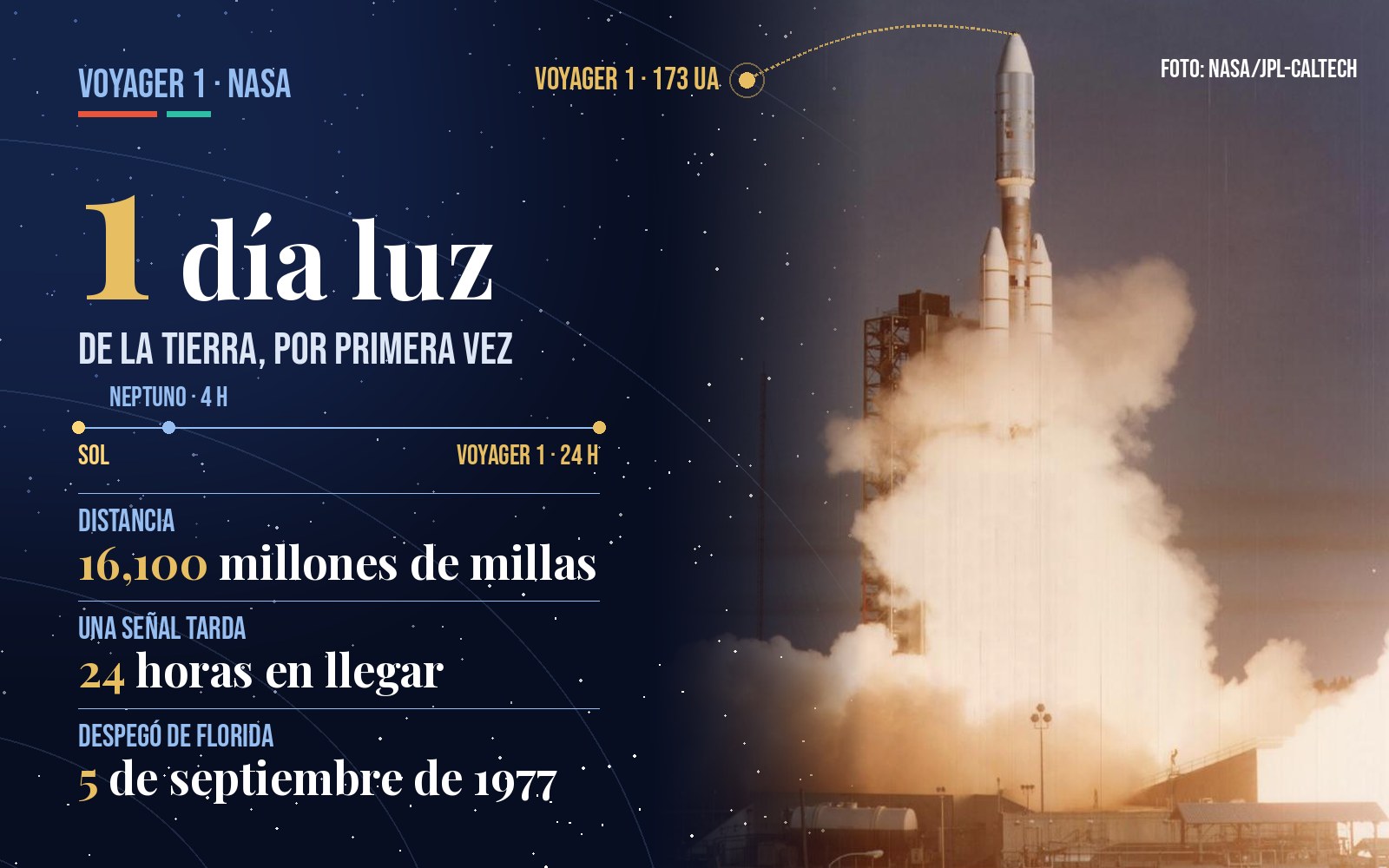
- A command sent from Earth today reaches Voyager 1 tomorrow, and its reply arrives the day after.
- Its twin, Voyager 2, won't reach one light-day until 2035.
Voyager 1 crossed the one-light-day mark at 5:16 a.m. Eastern on Wednesday, Nov. 18: about 16.1 billion miles, the distance light travels in 24 hours. No other human-made object has ever gone that far, NASA confirmed. From now on, any signal takes a full day to reach the spacecraft and another to come back.
It is 49 years old, and it left from Florida. It launched from Kennedy Space Center at Cape Canaveral on September 5, 1977, at 8:56 a.m., according to NASA's archives. It flew past Jupiter and Saturn, left the solar system in 2012 and is now 173 astronomical units away, 173 times the distance between Earth and the Sun.
What's on the Golden Record
Each Voyager carries a 12-inch gold-plated copper record, meant as a time capsule in case another civilization ever finds it. It was chosen by a committee chaired by astronomer Carl Sagan, and it holds 115 images, greetings in 55 languages, 12 minutes of sounds from Earth and 90 minutes of music, Smithsonian details. Instructions for playing it are engraved on the cover.
These are its 27 pieces of music, in the order of NASA's official list:
• Germany · Bach, Brandenburg Concerto No. 2 in F, First Movement. Munich Bach Orchestra, Karl Richter, conductor (4:40)
• Java · Court gamelan, “Kinds of Flowers.” Recorded by Robert Brown (4:43)
• Senegal · Percussion. Recorded by Charles Duvelle (2:08)
• Zaire · Pygmy girls' initiation song. Recorded by Colin Turnbull (0:56)
• Australia · Aborigine songs, “Morning Star” and “Devil Bird.” Recorded by Sandra LeBrun Holmes (1:26)
• Mexico · “El Cascabel.” Lorenzo Barcelata and the Mariachi México (3:14)
• United States · “Johnny B. Goode,” by Chuck Berry (2:38)
• New Guinea · Men's house song. Recorded by Robert MacLennan (1:20)
• Japan · Shakuhachi, “Tsuru No Sugomori” (“Crane's Nest”). Goro Yamaguchi (4:51)
• Germany · Bach, “Gavotte en rondeaux” from the Partita No. 3 in E major for Violin. Arthur Grumiaux (2:55)
• Austria · Mozart, The Magic Flute, Queen of the Night aria, No. 14. Edda Moser, soprano; Bavarian State Opera, Wolfgang Sawallisch, conductor (2:55)
• Georgia · Chorus, “Tchakrulo.” Collected by Radio Moscow (2:18)
• Peru · Panpipes and drum. Collected by Casa de la Cultura, Lima (0:52)
• United States · “Melancholy Blues.” Louis Armstrong and his Hot Seven (3:05)
• Azerbaijan · Bagpipes. Recorded by Radio Moscow (2:30)
• Russia · Stravinsky, The Rite of Spring, Sacrificial Dance. Columbia Symphony Orchestra, Igor Stravinsky, conductor (4:35)
• Germany · Bach, The Well-Tempered Clavier, Book 2, Prelude and Fugue in C, No. 1. Glenn Gould, piano (4:48)
• Germany · Beethoven, Fifth Symphony, First Movement. The Philharmonia Orchestra, Otto Klemperer, conductor (7:20)
• Bulgaria · “Izlel je Delyo Hagdutin.” Valya Balkanska (4:59)
• United States · Navajo Night Chant. Recorded by Willard Rhodes (0:57)
• United Kingdom · Holborne, “The Fairie Round.” David Munrow and the Early Music Consort of London (1:17)
• Solomon Islands · Panpipes. Collected by the Solomon Islands Broadcasting Service (1:12)
• Peru · Wedding song. Recorded by John Cohen (0:38)
• China · Ch'in, “Flowing Streams.” Kuan P'ing-hu (7:37)
• India · Raga, “Jaat Kahan Ho.” Surshri Kesar Bai Kerkar (3:30)
• United States · “Dark Was the Night,” by Blind Willie Johnson (3:15)
• Germany · Beethoven, String Quartet No. 13 in B flat, Opus 130, Cavatina. Budapest String Quartet (6:37)
You can listen to them on Miami Magic's Apple Music playlist, which gathers the record's pieces available on the platform. Some are in other recordings, and the field recordings aren't released there.
Meanwhile, in Miami
That year, Miami saw snow. On January 19, 1977, flakes fell in South Florida for the first time in recorded history, the National Weather Service in Miami recalls. They were seen from West Palm Beach to Homestead, even on the sand of Miami Beach, and by 9:30 a.m. they were gone. That afternoon, The Miami News put out a souvenir edition with a full-page headline: “Snow in Miami!”
Four days before the launch, on September 1, the United States opened its Interests Section in Havana, its first diplomatic presence in Cuba since relations were cut in 1961, according to the State Department. That same month, the Department later reported, some 55 American citizens and their Cuban families were allowed to come to the United States. On September 22 they landed at Homestead Air Force Base after a short flight from Havana: 31 American citizens and 24 Cuban relatives, the first people allowed to leave Cuba in more than a decade.
On the radio was a local band with a new name: Miami Sound Machine released its first album, “Live Again/Renacer,” in 1977 on Miami's Audiofon label. And the city's mayor was Maurice Ferré, re-elected in November with 67% of the vote.
In Miami, the snow of 1977 didn't survive past 10 a.m. On the day of the milestone, what wouldn't stop was the rain: more than 16 inches in 48 hours in Broward, according to the National Weather Service. The spacecraft that left Florida that year has been traveling for 49 years without stopping, and if anyone ever finds it, its record will play a mariachi band, Chuck Berry and Louis Armstrong: the same mix of worlds Miami was already becoming.
Sources
- CNN · La Voyager 1 llega a un día luz
- EarthSky · Hora y distancia del hito, según la NASA
- NASA · Foto del despegue (PIA21747)
- Servicio Nacional de Meteorología en Miami · La nieve de 1977
- Departamento de Estado · Relaciones con Cuba
- Departamento de Estado · Relaciones EE. UU.-Cuba (julio de 1978)
- Miami Sound Machine · discografía
- Elección de alcalde de Miami, 1977
- AP · La Voyager 2 llegará al día luz en 2035
- Septiembre de 1977 · el vuelo a Homestead
- The Miami News, 19 de enero de 1977 (Wikimedia Commons)
- NASA · El Disco de Oro (PIA14113)
- NASA · Punto azul pálido (PIA23645)
- State Archives of Florida · Florida Memory (fotos de 1977)
- NASA · Música del Disco de Oro
- Smithsonian · Qué lleva el Disco de Oro
