 Miami Magic
Delivery robots already roll down Miami-Dade sidewalks, and the county took their rules to a final vote
They belong to Serve and Coco, there are already more than a hundred and opinions are split. The Commission had the final vote on an ordinance with speed limits, permits, insurance and fines on its agenda for Tuesday, Nov. 17.
By Yolaxys Alvarez ·
- The final vote was on the County Commission’s agenda for Tuesday, Nov. 17. The outcome and the effective date are in the county’s legislative record.
- The ordinance always gives pedestrians the right of way: the robot must yield at all times.
- The full text of the ordinance is in that same record.
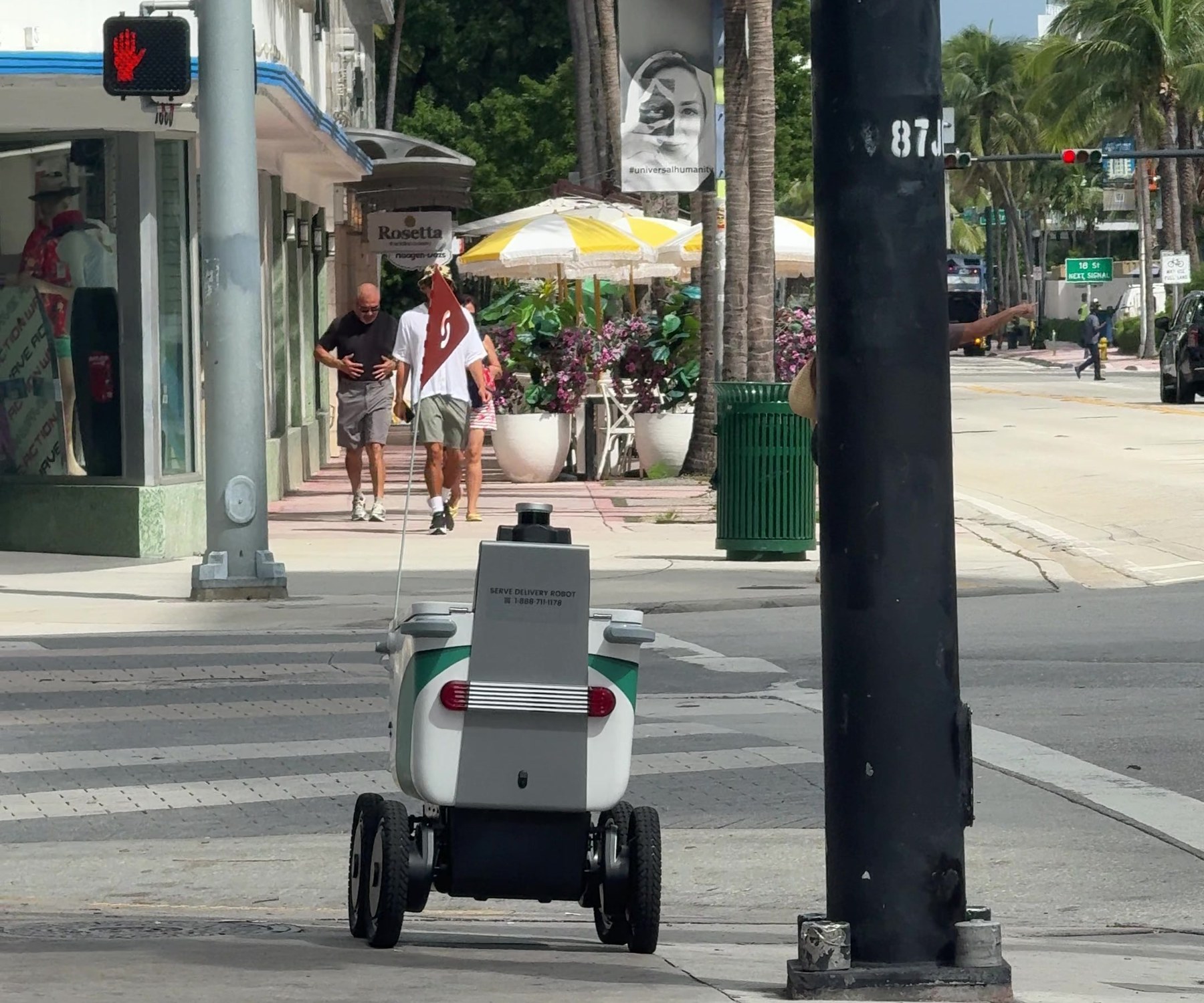
They wait at the red light like any other pedestrian, little flag held high, and they are already part of the scenery in Brickell, Wynwood and South Beach. The rules caught up with delivery robots: the Miami-Dade Commission had the final vote on the ordinance that regulates them on its agenda for Tuesday, Nov. 17. The text itself acknowledges that more and more of them are on the county's sidewalks and crosswalks.
Who owns them?
Two California companies, mostly. Serve Robotics announced in February 2025 its arrival in Brickell and Miami Beach, with Uber Eats orders and restaurants such as Shake Shack and Mister O1. Coco Robotics started that April in Wynwood and downtown, also with Uber Eats, and in November added DoorDash.
How have people taken to them?
Opinions are split. Some restaurants report more than a hundred orders a day that way. Among residents, some prefer them to a swarm of delivery bikes and others complain that they take up sidewalk space.
Are they coming to more neighborhoods?
Both companies talk about growing, without naming neighborhoods. Serve said on arrival that it would expand its Miami footprint. Coco said in April 2026 that its active fleet in the city topped 100 robots, spread across South Beach, Wynwood, Brickell and downtown. Under the ordinance, each company would need a county permit, and the county could limit how many robots operate in each area.
How fast could they go?
The text sets a maximum of 8 mph on sidewalks, 6 in high-pedestrian areas and 10 in crosswalks. Operators would have to enforce those limits remotely, with technology that restricts where and how each robot moves.
What must they carry?
The ordinance calls for a white light in front and a red one in back, and an audible alert that can be heard 15 feet away. Each device would have a unique identification number.
Who answers if something happens?
The company. The proposal requires a permit, renewable each year, and liability insurance of at least $100,000. It would have to report any incident involving damage or injury to the county within 24 hours, and remove a broken-down robot within 6 hours. Operating without insurance would cost a $500 fine, and each day would count as a separate violation.
Does it apply in every city?
Yes, countywide, though the text lets each municipality adopt its own rules, stricter or looser. The county could also limit hours and the number of robots in specific areas.
The proposal comes from Commissioner Micky Steinberg. The Transportation Committee approved it with changes on Oct. 14.
Sources
- Condado de Miami-Dade · Ordenanza sobre dispositivos de reparto, expediente 261932
- Serve Robotics · Llegada al área de Miami, 19 de febrero de 2025
- Coco Robotics · Lanzamiento con Uber Eats en Miami, 2 de abril de 2025
- DoorDash · Alianza con Coco en Miami, 13 de noviembre de 2025
- Coco Robotics · Flota en Miami, abril de 2026
- CBS Miami · Reacciones de vecinos y comercios, 1 de diciembre de 2025
- Refresh Miami · Más robots de reparto en camino, 19 de febrero de 2025